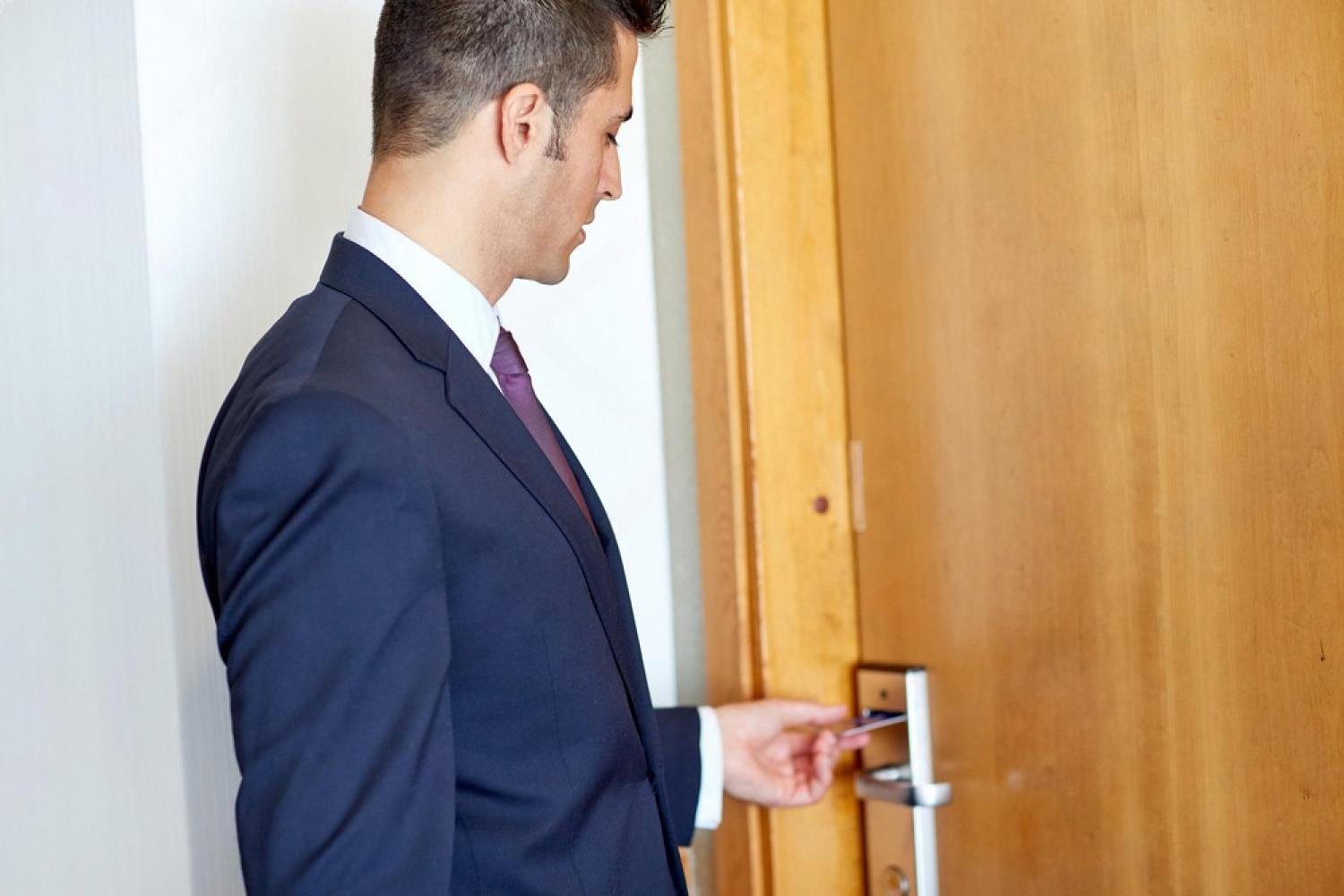
Buyer’s checklist for UAE hotels
Choosing an integrated self check-in and electronic lock system
Pairing online registration with electronic room locks is, right now, the fastest way to move a guest from lobby to bed. Before you sign a contract, there is a short list of things every property in Dubai, Abu Dhabi or Sharjah should verify. This guide walks through that list, then expands on the parts most buyers get wrong.
A guest can complete registration on their phone before arrival, or at a lobby kiosk in under a minute. If the kiosk is properly wired into your PMS and lock system, it pulls the booking, verifies the dates, captures ID, takes payment, and issues a room credential, a PIN, a mobile key, or a biometric enrolment, without a receptionist touching the transaction.
Why it matters
The business case in one paragraph
Front desk queues are the single most complained-about moment of a stay, especially in the UAE where late-night arrivals from long-haul flights are common. A well-integrated self check-in hotel kiosk shifts that pressure off your reception team, runs 24/7, and gives guests an arrival experience closer to what they already expect from airlines and car rentals. It also reduces the number of physical touchpoints, a factor the Dubai Department of Economy and Tourism has actively encouraged since 2020.
Done well, the payoff is measurable: shorter queues at peak times, fewer night-shift staff, and a lower rate of walk-away complaints. Done badly, you get frustrated guests standing at a broken screen at 2am.
The 8-point checklist before you buy
- Full PMS integration. The kiosk and the lock system must both talk to your property management system in real time. If your PMS is Opera, Protel, Cloudbeds or Mews, ask for a live demo against your exact version, not a generic one.
- Emirates ID and passport scanning. UAE regulations require guest identification to be captured and reported. The kiosk needs an OCR-grade scanner that reads Emirates ID (front and back) and passport MRZ, and pushes the data to the Tourism Dirham / police reporting feed automatically.
- Credential choice. Confirm the lock supports at least two of: RFID card, PIN pad, mobile key over Bluetooth or NFC, and optional biometrics. Guests want options, and mobile keys reduce plastic waste.
- PCI-compliant payment. Card readers must be P2PE or PCI-PTS certified. If the kiosk stores raw card data, walk away.
- Offline fallback. Ask what happens when the internet drops. A serious system keeps issuing credentials against cached bookings and syncs when the link returns.
- 24/7 technical support in the UAE. A vendor with an on-shore engineer who can be on site within four hours is worth more than a cheaper vendor answering tickets from another time zone.
- Audit trail and access logs. Every credential issued, used or revoked must appear in an exportable log for at least 12 months. This is a security baseline, and useful when a guest disputes a room entry.
- Arabic and English UI, with RTL support. Non-negotiable in the UAE. Ideally add Russian, Hindi and Mandarin for the top inbound markets.

Deep dive #1
How the credential is generated, and why it is safe
When a guest finishes registration, the integrated system does four things in sequence: it locks the reservation to that guest, generates a room-specific credential valid only for the booked dates, writes that credential to your lock database, and delivers it to the guest as a PIN, an RFID card, a mobile key or an enrolled biometric template.
Modern electronic locks use rolling codes and encrypted communication (AES-128 or better) between the lock, the gateway and the PMS. A PIN is not “guessable” in any practical sense: it is bound to a specific room, a specific time window, and is invalidated at checkout. Even a six-digit PIN gives one million combinations, and locks throttle failed attempts, brute-forcing a code before the stay ends is not realistic.
Biometric options, usually fingerprint or facial recognition, add a second factor. Templates should be stored as hashed vectors on the lock controller, not raw images, and should be deleted at checkout. Confirm this in writing with the vendor. The UAE Personal Data Protection Law treats biometrics as sensitive data, and the fines for mishandling it are significant.
What good integration actually looks like
One record, one guest
Booking, ID, payment and lock credential all reference the same guest ID. No re-keying, no email hand-offs between systems.
Instant revocation
If a guest checks out early, or if housekeeping reports a lost card, one click kills the credential across every door it opens.
Zero paper
Registration cards, signatures and welcome letters live inside the guest app or arrive by email. Nothing printed unless the guest asks.

Deep dive #2
Why 24/7 support is the item most buyers underestimate
A hotel runs at night. Late arrivals from Heathrow, Mumbai, Manila and Moscow land in Dubai between midnight and 4am. That is exactly when your night manager is alone at reception and exactly when a frozen kiosk causes the most damage to a review score.
Ask the vendor three specific questions: what is the guaranteed response time, is the first-line engineer based in the UAE, and do they hold spare hardware in Dubai or Abu Dhabi for same-day swap? A vendor who ships replacement units from overseas is not a serious option for a 100+ key hotel.
Also verify the escalation path. Level 1 handles UI issues and simple resets. Level 2 handles lock firmware and PMS integration. Level 3 is engineering. All three should be reachable within a documented SLA, not just “we’ll get back to you.”
Reference table: what to expect at each price point
| Tier | Typical setup | Best for | Watch out for |
|---|---|---|---|
| Entry | Tablet-based kiosk, RFID lock retrofit, cloud PMS connector | Boutique hotels, 20-60 keys | Limited offline mode, single-language support, no biometrics |
| Mid | Freestanding kiosk with ID and passport scanner, PIN and RFID locks, mobile key, on-shore support | 3 to 4 star hotels, 60-200 keys | Firmware update cadence, PMS version lock-in |
| Enterprise | Multiple kiosks per lobby, biometric locks, PMS + POS + door control integration, dedicated account manager | 5 star and resort properties, 200+ keys | Long procurement cycles, custom integration work billed separately |
Prices vary too much by property size to publish useful figures here, but the pattern holds: the entry tier looks cheap until you count the receptionist hours you still need, and the enterprise tier looks expensive until you compare it to a full night-shift headcount over 24 months.
A short note on guest experience
Not every guest wants a kiosk. A returning VIP still expects a human welcome. Design the flow so self check-in is the default for guests who want speed, and the front desk is reserved for guests who need or want service. The kiosk should never block the human path, it should relieve it. Properties that get this balance right, based on published industry reporting see both faster check-ins and higher guest satisfaction scores, not one at the expense of the other.
Frequently asked questions
Is a PIN code really secure enough for a hotel room?
Yes, when it is implemented correctly. A room-specific PIN is bound to one door, one date range, and is invalidated the moment the guest checks out. The lock throttles failed attempts, usually locking out after 3 to 5 wrong tries, so brute-forcing a 6-digit code inside a normal stay is not realistic.
For higher-risk properties or executive floors, layer the PIN with an RFID card or a mobile key so entry requires two factors.
How does self check-in handle UAE guest registration and police reporting?
A compliant kiosk scans the Emirates ID or passport, captures the required fields, and pushes them to your PMS. The PMS then forwards the guest record to the Tourism Dirham system and the relevant police reporting endpoint automatically.
Confirm during the demo that your vendor already handles the current Dubai, Abu Dhabi or Sharjah reporting format. Each Emirate has slightly different requirements.
What happens if the internet goes down while a guest is checking in?
A serious system runs on cached data for the day’s arrivals. The kiosk can still verify the booking, issue a credential and open the door. When the connection returns, it syncs the transaction to the PMS and the reporting feeds.
Ask the vendor to demonstrate this offline mode live, not just describe it on a slide.
Can we use mobile keys instead of plastic cards?
Yes. Most modern electronic locks support Bluetooth or NFC mobile keys delivered through the hotel app or a wallet pass. Guests unlock the door by holding their phone near the lock, no card issued at all.
Keep RFID cards as a fallback for guests who prefer them or whose phones run out of battery.
How long does it take to install an integrated system in an existing hotel?
For a 100-key property, expect 4 to 8 weeks from contract signing to go-live. That covers PMS integration testing, kiosk installation, lock retrofitting or replacement floor by floor, staff training and a soft-launch period.
Retrofitting locks is usually done room by room during vacancies, so occupancy is not disrupted.
Do we still need front desk staff after installing self check-in?
Yes, but fewer, and with a different role. The kiosk handles the standard arrival flow. Reception staff move to concierge-style tasks: greeting VIPs, resolving edge cases, upselling and answering questions the kiosk cannot.
Most UAE properties keep at least one team member visible in the lobby around the clock, both for hospitality and for kiosk assistance.
What should the vendor’s SLA look like?
Look for a written commitment covering response time (ideally under one hour for critical issues), on-site arrival window (four hours is the benchmark in Dubai and Abu Dhabi), spare-parts stock held locally, and firmware update cadence.
Avoid vendors who only offer email support or whose engineers are based outside the UAE.

Surfer, doer, hiphop head, hand letterer and identity designer. Operating at the sweet spot between minimalism and computer science to save the world from bad design. My opinions belong to nobody but myself.